TAJ MAHAL

TAJ MAHAL
Namaste and good morning. We took a horse drawn carriage to the Taj Mahal this morning.  
It is a peaceful setting. Early morning and the haze is lifting. Revealing blue skies. Sweet birds singing in the huge green tree coverings. White marble stones make up the mighty Taj. No lighting allowed within the palace.  
Cover our feet in white cloth to enter the palace and burial site of once emperor and his beloved wife. He was emperor for thirty years. She was his third and last wife. They had 14 children, 7 died in infancy and she died giving birth to the last. 4 boys and 3 girls survived. Later the youngest son killed his elder brothers and took over as emperor, imprisoning his father for his last 8 years of his father’s life. The daughters also lived in the palace at red fort and cared for their father, where he was kept captive.  
Marble inlaid with semi precious stones, jade, carnelian and others. Malachite, topaz, jasper, lapis lazuli, turquoise, … many imported from different places in the world.  
Stunning sight. Beyond words. White marble bricks inlaid with mother of pearl so on full moon, like tonight … It glows at night. The Emperor could see this tribute to his wife from his home at Red Fort.
****
Next stop marble art studio to show how Taj Mahal was made in delicate detail. This art is only done by artisans direct descendants of the original and only in Agra. Beautiful marble items in exquisite detail, inlaid with precious stones.  
Then we went to the red Fort, size over 2.5 kms. Largest fort in India. Royal stories. Still used by army. Beautiful courtyard and gardens, Indian unique beveled archways. Preserved in time and red sandstone. Great dynasties have lived here and met with their own people in central place for Public audience. White marble structure is private mosque for the Royals. 
Peacock is national bird of India. We have seen them wild and in marble. Also great elephants in this land are revered. Stories of Royals and elephants … Elephants carved in marble … All very interesting. In this country also are tigers and lions. Very exotic.
We had a catered authentic Indian lunch and listened to a performer playing stringed sitar. Then we returned to the beautiful upscale Trident hotel.  


DAY TRIP of Delhi and on to AGRA

Day Trip to AGRA
After breakfast this morning, we 17 met in the lobby, cleared our bills and brought our luggage to the bus. Pick up was arranged at hotel for 9 am and we met our guide Mr Luv. He will be with us – and his team of driver and assistant, for the entire two weeks. He is lovely, kind and well informed.
He informed us of a few facts as we toured the city of Delhi and New Delhi. Namaste is the greeting used widely in this country despite many languages spoken. Guests are considered like gods and service is very important. Delhi is the second largest city in India, 20 million population. Mumbai is the largest with 22 million. India is the second largest country in population, next to China. There are 1.5 billion people living in India.
Delhi is rich in diversity of all kinds. Religion categories include Hinduism which is the oldest religion practiced by 82% of the population of India. Followed by Muslims at 12.5%, and third Christians at 2.5%. The Sikh religion is 400 years old, relatively young in age and less than 1% practice, .7%. Buddhism is practiced by less again. Why? We will talk about it more another day. The city of Delhi is the city of dreams and opportunities with many universities and educational facilities.
Delhi is the book that narrates the history of India. Del means heart and this city is the capital of India. 20% of the city is covered in green space. 180 sq miles is this city.
Diversity is also seen in wealth, with the very very rich and the very very poor. All people sail and are enjoying life and are happy, says Luv. This makes India a most exotic destination and different from any other. Our tour is called Royal India and we will learn about the land of the Kings and Queens of India.
India has been taken over some 7 times in history. This 26 January marks Republic Day, a celebration of independence for India. India celebrates many festivals for such things as full moon, half moon and no moon! Life itself is about celebrations and happiness, says Luv.
Our first stop is Qutab Minar. It is a very ornately carved and stunningly beautiful minaret situated in a park like peaceful setting with plenty of green space and many ruins around it.
Neem trees are medicinal, used for toothbrushes.

Referred to as the Tower of victory, this Minaret is the tallest. 72.5 meters, 379 steps, 5 stories and considered the “Pride of Delhi”. From 7 and 8 century this was a place of worship.  Rulers took over and divided the people and tried to stop the religion. In 1199 began construction of the World largest brick minaret.
Looks like lotus flower in ground from aerial view. Access is closed here due to suicides. Also on the property is the “Tower of Jealousy”. Calamities happened and it was never finished.  Karma???  Past rulers demolished all temples that were here prior .. Now just the ruins remain …

Also, we were treated to see the first mosque, which faces to the west. More mosques in India than any country in the world. First mosque and largest mosque in Delhi and New Delhi.

We also visited today the Lotus Temple, which is the Baha’i House of Worship. It is made completely out of white marble and has 27 massive lotus petals. Once inside we were treated and blessed by the chanting and prayers. The sound was so moving it brought tears to my eyes. What an experience!
Lotus flower is symbol of creation and is the seat of the thrown of Lord Brahma, God of creation. The temple to him is in Pushkar and we will go there later on the tour.
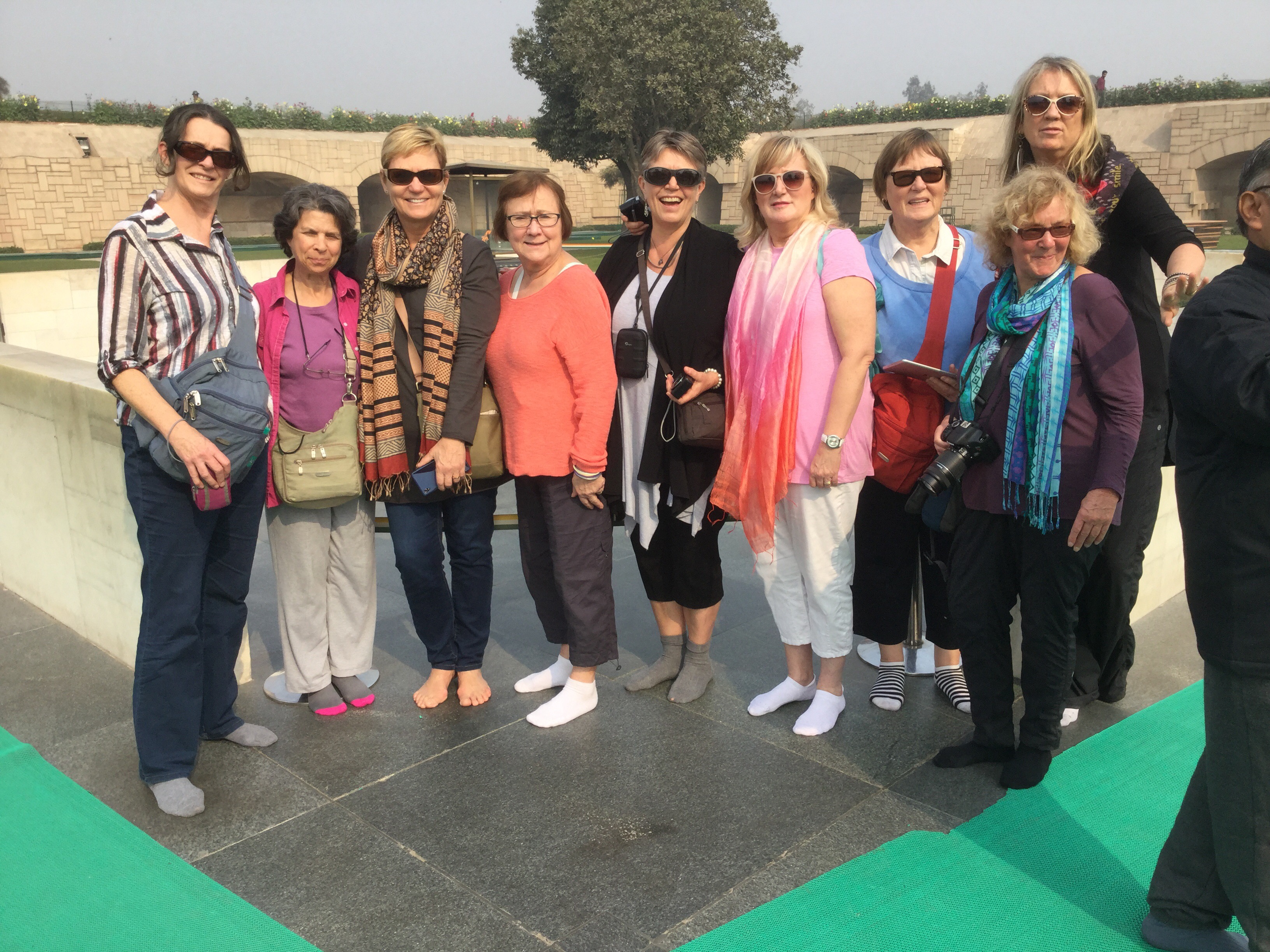
Lastly we stopped at the burial and cremation ground of Mahatma Ghandi – another powerfully moving place.  Security is high in Delhi, in preparation for the Independence Day anniversary celebration in a few days time …. however we are making our way :).
Tomorrow we will tour the Taj Mahal. Described as a poem of love in marble. We will stay tonight at the Trident Hotel in Agra, part of an Indian chain of hotels of very high quality. It is considered an oasis in Agra.
Namaste
Pamela


The MOON

The MOON in New Delhi
It’s four in the morning and a new dawning in New Delhi, India. Under the full moon I wake and wonder.
What is life like at this time of day in this place? Young and old, families and singles who live in virtual homelessness on the streets may also be looking up at this same moon.  
It is cold here at night, this time of year. Not cold in Canadian standards, but relative to the day time. It is the coldest ever in Delhi I am told, around 8 degrees at night. Up to the early twenties (degrees C) during daytime, very pleasant for walking around and feeling the sunshine as it strains to reach the earth through the smoggy grey air.  
Today I anticipate sweet moments spent with travelling buddies. Hopefully a woman driven cab, we will venture for a few hours to see “her” India. A little time to shop in a more modern upscale designer location. Perhaps back to that local foodery where the price is reasonable and the portions plenty, with flavours of local pride and joy.  
Namaste, 
Pamela
Plans for today: gather all the gals who are not otherwise booked to go on a private tour. We plan to see Chandhi Chowk for wander through Khari Spice Market, Chawni stationery, Delhi haat handicrafts … Then Anokhi store on 32 Khan Market. Akshat Dham Temple and a few other sacred sights. Dinner back tonight at Hotel (another word for restaurant) Saravana Bhavan.  

TukTuk

TukTuk ride  
Five of the gals went out to dinner in an authentic lovely Indian restaurant and and took a cab to get there. The driver was very unsure of how to get there. The cabs offer to stay and wait and bring you back, of course, for a fee. We were unsure how long we would be, and sent him on his way back to take other fares.
 Hotel Saravana Bhavan (South Indian High Quality Vegetarian Restaurant), 50 Janpath, New Delhi. Dinner was fantastic, lovely flavour, much choice and frequented by locals. We all purchased bottled water to drink.  
And then, hailed a Tuktuk for a ride back to the Met hotel….
He pulls over, sign says “off duty”. Male driver in the front seat of this tiny green and yellow vehicle. It has the steering of a motor cycle, the inside like a small car. With a back seat, open sides, a windshield and roof, a few places to grab on. Four women in the back sharing the equivalent of two small seats. One passenger is to share the front single seat with the driver. We negotiated a fare, and agreed on a price. Away we went.  
With a feeling of hanging out in the road with no protection from the elements or on coming traffic, this little vehicle zooms in and around other vehicles, pedestrians and even on sidewalks! Honking all around. People wandering the streets, poverty along the side of the roadway, shops and cafes open to the street. The driver, with fun in his voice and a glint in his eye, refers to the ride as a Helicopter. We giggle and hang on tight.
The end of day one in India. We have been here about twenty hours.  
Namaste, 
Pamela and the travelling women 


First day in New Delhi

FIRST DAY in New Delhi
A quiet and restful sleep upon arrival at the Metropolitan Hotel and Spa. We are sheltered by the extremes of India, with air conditioning, and muffled sounds outdoors. Bottled water a plenty in our rooms, we start rehydrating.
The air here is heavy, grey with pollution. Thick hazy skies even last evening as we were departing the airport, a ring of grey air surrounded the lights.  
This morning there are birds flying overhead giving life to the skies. A great view out the hotel window of the buildings on the block, and the swimming pool below. Workers outside sweeping with large long bristled brooms.  
Sounds on the streets are louder than at home, planes overhead, banging of construction, honking of cars and activity everywhere.  
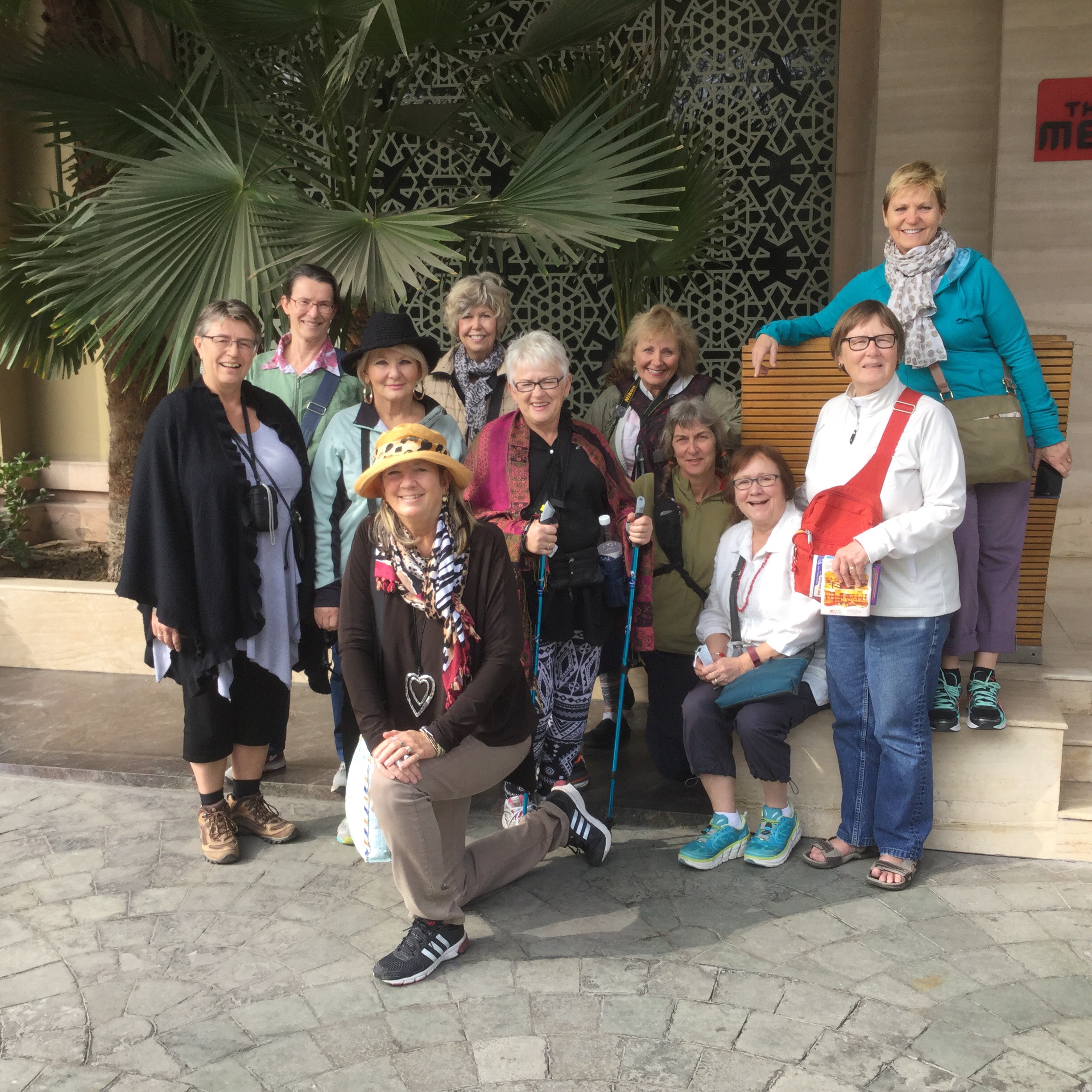
We meet up in the cafe in the hotel for complimentary breakfast, and arrange to go for a walk around the city. I feel safe joining with some of the gals who ventured out yesterday …. Not because they know where we are going, but because the familiarity with the customs, somewhat, and because I love the company of others. We are 12 in total at the hotel, 11 venturing out together in the late morning, about 1045ish a.m. As the day progressed and individual interest shift, we are 6 coming home together walking.
We came upon a bangle market … Rows and rows of bright and vibrant colours, rings and rings of bangles to adorn. Metallics, and many made of glass. I spy and am happy to say, purchased a dozen wire wrapped bangles covered in very bright threads, sunny golds, navy blues, brick reds, forest greens.  
So much of shopping is about the personality of the vendor. I noticed today that price for me is not as important. I want to purchase from a woman, although that is not always possible as most of the vendors and shop keepers – as well as business people I see on the street, are men. And then how attentive but not overbearing are they? Willing to negotiate a bit? Do they hear objections and ready to make alternative suggestions? A sale, any sale, seems to be based on the gentle scale leaning in favour of the first person able to make the connection with the person willing to part with precious rupees in exchange for a local trinket. Interesting to watch and observe how it all goes down.  
Another stop for several of the women to get the henna tattoo initiation. Select a photo from a book, negotiate a price, and in a moment it is complete. Then waiting 10-15 minutes for the brown mixture to dry and set to the skin. Again, one woman and several men each with a little table and chairs scattered in an open space. Incense burning and little items of a personal nature the table. Surrounded by intense eyes, we are watched closely by locals.
I don’t feel unsafe, however I feel observed. I notice that eye contact is freely given and so the place has an air of friendliness to me, human connection not withheld. I feel welcome in this city and although there is a lot of street presence, people with hands out looking for money, they seem not to be ashamed. They welcome my eyes with smiles and friendly glances, eye to eye. I shake my head no to the ones who are more assertive with requests for hand outs, and the others, I feel a mutual exchange of NAMASTE. Sweet really, and unexpected.  
Wandering in and out of crazy traffic we are guided to a shopping district. Clothes, handicrafts, foods … 
Yesterday four of the travelling gals had located and scouted out a shop of fabric, silks, saris, and scarves. They were not sure they would find it again but had promised “Anita” they would bring “Pamela” to the shop …. By complete accident we find that same store!! Beautiful items to behold and bolts of the most exquisite silks.  
Anita has a keen sense of colour and reading personality of the customer. She is certainly a sales person, and she is determined to find the right fit. I had on my list to have made a silk robe and pyjama bottom combo. She assures me this can be done and delivered to the hotel tomorrow evening so I can take it with me on the trip.
Silk is pulled off the shelves and draped on bodies, observed and enjoyed in the mirror. Tea is served, bottled water offered for me, and use of western style toilets are provided – to my relief. Selections are made. Some gals follow my lead and order for delivery. Some gals have other items made of a more practical nature, a pair of cotton pants and long tunic style shirt. Some purchase scarves off the shelf. And many of our group try on and learn to wear Sarees.  
I love the experience. By then, 8 women from our group all touching fabric and feeling taken care of in this lovely store. When we leave there is fabric of the richest colours and textures ever to be enjoyed, strewn about the counters and many faces of store clerks watching as we go. Their job now to repackage the items left behind and get to work sewing and tailoring our new purchases for delivery tomorrow.  
I feel fulfilled for a first day and relaxed about my great India adventure. I will seek mindful moments and human connection on this almost month long journey.  
Thanks for joining me and NAMASTE from New Delhi, India!
Pamela


SAFE TRAVELS to INDIA

SAFE TRAVEL to India, Delhi
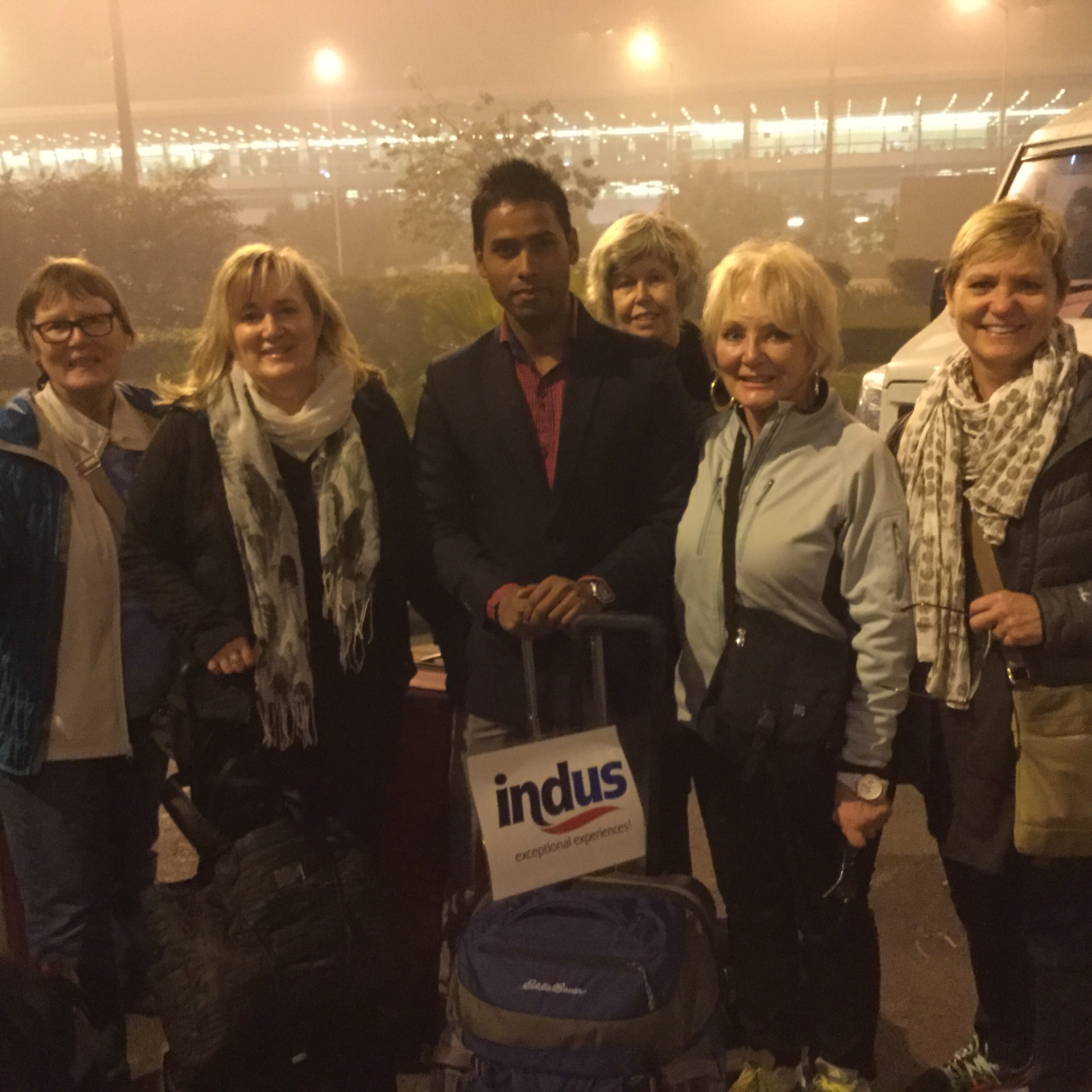
As the plane lands and is taxiing on the runway, a surge of excitement occurs. We have arrived. The gentleman beside me on the plane states proudly and kindly ” welcome to Delhi”. He is a most pleasant man, who calls Delhi home and was away on business. He is part of a flooring company and was at a trade show. He watched movies and I tried to sleep.  
After two very long flights since departing Vancouver, on lovely carrier Air France, I see blackness outside. Nine degrees outside states the announcement. Lights marking buildings and lane ways for the plane to traverse for safe arrival. 13.5 hours ahead of BC time back home, it is tomorrow.
Ears tender from the decent from high flying altitudes, I am happy to be leaving the seat 20j since Paris. I am grateful for this direct flight schedule and no delays. I am searching the overhead map on the screen for familiarity and find some names of places our tour will take us over the next few weeks.
Welcome to my India vacation. We will meet soon with the other gals on our 17 guest tour group.  
Stay tuned, faithful blog followers, the best is yet to be!
Welcome to India.

A travel journalist talks about being an Ambassador

HI folks, a dear friend posted this  on my Facebook site and I thought you might like to check it out.

She speaks about travel as a way to practice being an Ambassador, a peace maker and a story teller.  Travel educates us and makes us richer.

Join me  https://www.youtube.com/watch?v=GErjagMyrYk

Pamela MacDonald
Your “travelling” Cruise and Land Travel Specialist
EXPEDIA CRUISESHIPCENTERS, VICTORIA BC
office (250) 381 7447
Cell (250)857-5518
Manulife Insurance  is always recommended for your travel protection https://www.igoinsured.com/TravelWeb/auth/mlwd/forms/MWTakeOne.pdf
Check out & ‘follow’ me at www.PamelaTravelBlog.com
Join me at the http://meetup.com/Womens-Travel-Club and or
This is a great resource for Travelling Women:  http://travel.gc.ca/docs/publications/her_own_way-en.pdf

Embarking on India 

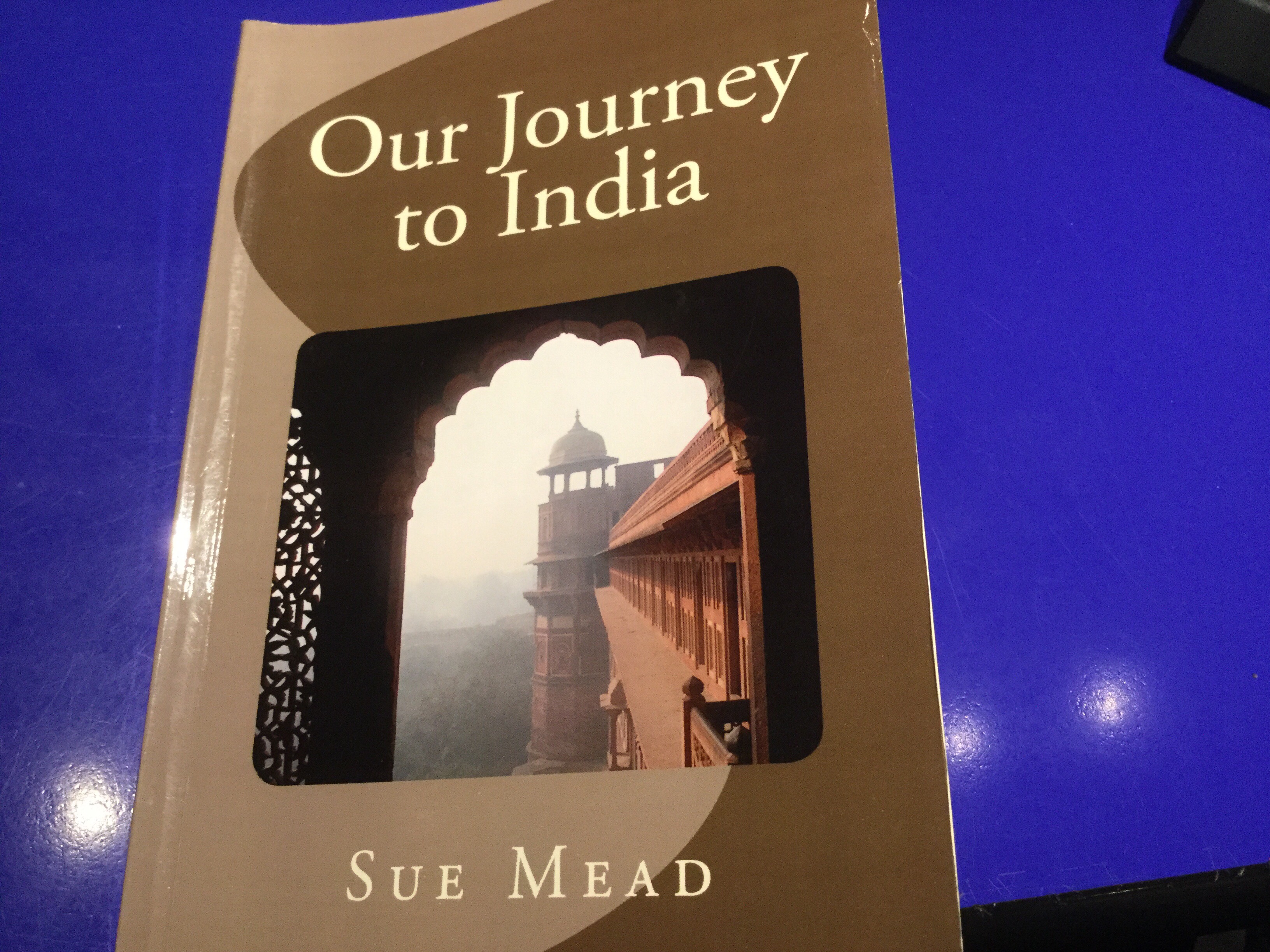
From the book: The book: Our Journey to India by author Sue Mead, 2009

Embarking on India

Reading a book written by a woman who ventured to India a few years ago. The book was borrowed from one of the gals, one of 17 of us, now booked for India next month.  
She packed big rolls of toilet paper in her luggage, took the ferry over to Vancouver for her flight in a January day. Her plan was to go for a month, and take as little in her luggage as she could manage. Insect repellant, laundry powder, instant coffee, clothing, a sleeping bag and travel towel were a few items she had packed and checked through to New Delhi airport. They had a stop at London Heathrow and a previously arranged family meeting so they could go out for a good meal. Nice idea! Then they requested an upgrade and got it! Business class! Wow!  

They indeed popped malaria tablets as prescribed, with some wine and a meal. Oooops, luggage did not arrive as scheduled. They were greeted with pollution, traffic and honking as they rode into town. Not angry honks, just simple communication between vehicles.  
Then children start to swarm their cab. Oh dear … Those faces. Those fingers reaching in the open window. Garbage strewn about and animals foraged. Dogs, cows and goats. Even monkeys!  

Temporary shelters from scraps of cloth and cardboard seem to be homes for local families. Millions of people in unimaginable poverty live in India. Nothing prepares us for this sight.  
(“observe, not judge” would be my new motto to strive for on my upcoming trip. Observe and report to the blog. Shine a light on what I experience. Show up, strong and open. Feel the feelings and try to let them move through. See it, feel it and be changed by it.) Pamela 
Negotiating with a rickshaw before getting in. Know the fare and stick to it. A scarf pulled up over the mouth to reduce the taste of traffic.  
A leg-less beggar man with leprosy grabs at her leg, looking for money. Oh my! She is in tears. Deep breath. A young emaciated girl pushes her baby in their way, looking for a handout. “Young and old, aggressive and meek, leprous and maimed, all seemed to be here, working the crowd. To be found on every corner were vegetable stands, fortune tellers, sweet sellers, chai stalls, ear cleaners, pick pockets and holy cows.”  
Remember to bring a plug for the sink! For a wash …. And have a shower when you get a chance … Otherwise maybe do without? And “wash up” from a bucket. Argh …. 
(This book and the writing style, describing almost unbelievable experiences leave emotions raw … Very sad and then laugh out loud!) Pamela 
For two dollars an hour they hire a driver and car to take them around. The price for foreigners and locals is different, $.25 locals, $2.50 foreigners. Keep he difference and your privilege in mind! Foreigners are fortunate enough to pay even that higher sum.  
Trying to find clothes that fit the North American woman body shape seems more of a challenge, for the gal who lost her luggage in flight. Seems some locals wear jeans! I wonder where they purchase them?  
Eating, dining, always with the right hand and sitting on the left to keep it out of the way and not tempted to use left as a utensil! And the trick is to learn to not have sauce half way up the arm.  
How does one enjoy a vacation alongside the poverty, injustice and oppression? It seems the caste system is alive and visible to all that visit this country. Are there no social programs? And what do people get outraged about, if not human suffering in their midst? Humility and privilege … To find balance.  
One of the personal growth qualities to work on when planning a trip to India is patience. Develop and practice patience.  


India, from Along the Path, pdf

INDIA (excerpts from ALONG the Path (book) free pdf)

India is India, because it is not like home!

“Most people never travel. They simply transport the mad loop of their brain’s thoughts from place to place. To truly travel is to stand on the fields of yourself where you have never stood before. “ – Speed Levitch

“India will bend your mind, assault your body, flood your senses, and shred your nerves, from the moment you step off the plane into its smoky unforgettable perfume of burning cow dung, diesel fumes, and a few thousand years of accumulated human sweat. And ultimately, if you’re lucky, your old identity will break down like one of the decrepit, smog-belching auto-rickshaws that clog the Indian streets—and you’ll have to walk on without it, through the twisting alleys of an unknown city, with cows eating empty juice cartons from street-side garbage dumps and ash-daubed mystics chanting mantras in the gutters. It’s this breakdown and the attendant possibilities for transformation—more than a specific teacher or spiritual site—that’s the real blessing India has to offer. “ – Ann Cushman & Jerry Jones, From Here to Nirvana

You don’t need to go to India to look inside. But those who do inevitably come back transformed. Sometimes the changes are radical. Other times, their inner journey manifests itself in subtle details: a glint in their eyes, a silent presence, a fluidity in their stride, or a special glow (even if a few pounds lighter). They may be shaken by the poverty and suffering they have seen, and have vowed never to complain again about their petty problems. They may notice details that escaped them before, or see the magic in simple conveniences like a hot shower or tap water that can be drunk without worry.
Travel has a way of extracting us from our daily grind and making us look at our habits and ways of life. We re-evaluate everything that makes up our life back home—relationships, work, time—and decide we need to make some changes. Or, if we’re lucky, the changes may just happen on their own.

Travel, however, can be especially moving when it is taken as a pilgrimage (yatra), not only through the outer world, but more so in discovering the inner world and the dark mazes of the mind. It seems to be in the nature of a pilgrimage to test our limits. But if we surrender to the journey, without looking for the final goal, we can find peace and joy in the present moment.

This book is meant to travel to India with you, to accompany you on bumpy bus rides and when you’re waiting three hours for a delayed train. It’s also meant to provide inspiration along the way, to support your meditation, and to be a reminder of why you came to India in the first place: to have equanimity with all obstacles India may throw at you.

The danger of guidebooks, however, is that every single place mentioned seems so alluring that many people fall into the trap of wanting to ‘see it all.’ Although a vague plan is sometimes helpful, be prepared to chuck it if you find a place you like and want to stay longer.

“At no time are we ever in such complete possession of a journey, down to its last nook and cranny, as when we are busy with preparations for it. After that, there remains only the journey itself, which is nothing but the process through which we lose our ownership of it.” Yukio Mishima, Confessions of a Mask

Winter (Hemanta): mid-November to early February.
Indian winters can get quite chilly in northern cities like Delhi and Jaipur. During the day you can wear long sleeves without sweating; at night, you will need a sweater, a shawl, or both. In the south, it is pleasantly warm, without being too hot. The cool season is pleasantly mild—not too hot, not too cold. You start shedding the thicker layers, and before you know it, you’re wearing a T-shirt.

There are different kinds of travellers. Some people love to temple-hop and visit every single World Heritage Site in a 1 000-km radius, whereas others prefer to get to know the locals: how they live, how they eat, etc. Whatever your temperament, be warned that travel in India is slow, even when it is ‘deluxe’ or ‘super-fast.’

You will never see a crow within a flock of parrots, or vice versa. In the same way, friends travelling together tend to share common goals and interests.

If you’re planning a trip with friends, everyone should have a say in the preparations, so that nobody is held responsible when things don’t work out precisely according to plan.

Be sensitive to your travelling companion’s budget. If you are travelling for a long stretch together, it’s true that “Good accounts make good friends.” But a “what- goes-around-comes-around” attitude is handy for short partnerships; you may treat someone to a 40-rupee rickshaw ride, and the next day, someone else may treat you to a meal.

The popular saying “In India, anything is possible,” not only applies to the bank clerk hinting for a bribe, but to the daily miracles of bumping into a long-lost friend on a Himālayan mountain pass, or a car offering you a ride to exactly where you want to go after your rickshaw breaks down on a rural road in the dead of night. But the only way for these miracles to happen is with an unwavering trust that everything will be okay. The naïve traveller goes for the impossible by attempting to impose order on what is chaotic. The illusion of control, as you pack your bags, design a travel itinerary, buy your plane ticket and make reservations, is bound to be shattered within the first few days, as the simplest task becomes a day-long operation involving several bureaucratic layers.

India is a gastronomic paradise for vegetarians. Who knew that you could produce so much variety with grains and legumes? We suggest that even non-vegetarians stick to a veggie diet in India because bad meat is a prime cause of food poison- ing: who knows what conditions the animal was brought up in, how the meat was stored, and how it was cooked? Even without meat, there is so much diversity from which to choose. To be safe, we try to go for ‘Pure Veg’ restaurants if we have the choice, which means that they don’t use eggs or onions, and that the food has not come in contact with any meat.

TEXTILES

Khadi means hand-spun and hand-woven natural textiles (cotton, silk and wool), where the entire process, from picking the cotton or shaving the sheep, to dying the fabric, is performed in a non-violent way. Khadi-makers also say that because of their unique weaving technique, khadi is the coolest and most comfortable fabric (although it may initially be quite rough, after a few vigorous washings it will become as soft as baby clothes).

Gandhi started the khadi movement as a way of boycotting British textiles and making India self-sufficient. He encouraged every Indian to spin cotton a couple of hours every day as a form of protest as well as a meditation. Gandhi considered wearing khadi a moral duty, and even that it had beneficial psychological and spiritual effects on the person who wore it.

You can find khadi shops in almost every town, although the big cities usually have a much wider selection. In Mumbai and Delhi, the khadi bhavans have ready- made clothes as well as uncut fabrics, and fabulous shawls. (If you buy fabric and want to have it stitched, make sure you find a reliable tailor, because once you’ve spent the money on expensive raw silk, it’s a shame to have it ruined by a bad cut or sloppy job.)

In most khadi shops you can also find village industry products, which are all produced in a non-violent way. You will find honey, jams, pickles and chutneys, woven baskets, handmade paper, pottery, oils, shampoo, incense, soap and leather products made from animals that have died natural deaths.

In a country where the mechanized industries have put thousands of people out of work, encouraging the local artisans has a concrete effect.

The North: Delhi
India’s bustling capital is usually a source of severe culture shock for travellers arriving in the subcontinent for the first (or tenth!) time. The city’s manifold extremes expose your senses to a myriad of contrasting realities: modern high rises hovering over makeshift slums and hutments, spired sandstone temples and domed marble mosques; streets crowded with continually honking cars fender-to-tail against cows meandering amidst the frenetic traffic of rickshaws, motorbikes, pedestrians and vendors. You’ll find McDonald’s restaurants just steps away from street stalls selling samosa, pakoras, fresh fruits and mysterious unknown edibles; the delicious aromas of curried vegetables and sandalwood perfumes blending with the awful stench of urine, cigarette smoke and diesel fumes. Sellers and eager touts add a chorus of calls to the sensory confusion, singing “Cheap tickets,” and “Come see my shop,” while gleeful children play street cricket and well-dressed business- men talk on their mobile phones, all sharing sidewalk space with aged holy men wearing dhotis, chanting mantras and asking for alms along streets where ATM machines spit out rupees a mere stone’s throw away from shrines for religious deities offering salvation to both the financially and spiritually poor.

This exceptional city is divided into two sections: Delhi (or Old Delhi) and New Delhi, though the greater capital area now includes a growing suburban sprawl and several satellite cities. Old Delhi, or Shahjahanbad, was the intermittent capital of the Mughal Empire between the 12th and 17th centuries, and today remains the primary Muslim sector, with its innumerable mosques and tombs, halal restaurants and butcher shops, markets and forts. Majnu Ka Tila, the relaxed Tibetan refugee and foreign tourist centre, is also to be found in Old Delhi. New Delhi was originally designed as the British capital after the imperial government shifted its head- quarters from Kolkata, and the city continues to be India’s capital. Today, this part of Delhi is a fairly open green space, with wide avenues, tourist ghettos, exclusive gated communities, government buildings and foreign embassies.

Shopping, Activities, Services & Sites
Delhi is a great place to satisfy most of your travel needs or buy souvenirs to bring back home. Pahar Ganj, Delhi’s ubiquitous travellers’ ghetto, is crammed with shops selling all sorts of stuff, though shoppers will have to look hard to find quality products here. Nestled between the Red Fort, Jami Masjid, and Fatehpuri Masjid in Old Delhi is Chandni Chowk, a congested yet colourful bazaar where you can get good deals on household items, art, jewellery, carpets and perfumes.

Connaught Place in central Delhi is made up of uniformly concentric ring roads lined with boutique shops, street stalls, restaurants, and hotels. The 3-storied Khadi Bhavan in Connaught Place is one of India’s best retailers for khadi, or home- spun cloth. Around the corner in the Regal Building, The Shop has excellent, high quality clothing, linen, furniture, ceramics, incense and essential oils; and People Tree, an artisan’s collective boutique, carries a unique assortment of printed t- shirts, clothing, decorative items and books. Fab India and Soma are also popular Connaught Place choices for ethical clothing, handicrafts and furniture.”

Book lovers will become infatuated with Connaught Place’s numerous bookshops and pavement stalls, whose books are much cheaper than in the West.

On Janpath, just off Connaught Place, you’ll find the Central Cottage Industries Emporium, which has, primarily, high-quality goods from around the country; convenient for shoppers but more expensive than elsewhere in India, as with most shops in the city. Around the corner on Baba Kharak Singh Marg are state emporiums selling handicrafts from their particular states.

If you’re really keen on shopping, trek out to the N-Block and M-Block of the Greater Kailash suburb where you’ll find excellent high-end stores such as Fab India selling clothes, furniture, kitchenware, bedding, art, handicrafts, jewellery, carpets and more. Fab India also has a smaller boutique clothing stores in Connaught Place (28 B-Block) and Khan Market, a high-end shopping enclave in central Delhi.

For moving about Delhi, taxis and their less expensive counterparts, rickshaws make life easier, although drivers usually refuse to use the meters or show you the fare conversion cards. Tourists are big business, and you should expect the initial asking rate to be anywhere from double to five times the price accepted by locals. Be aware of the distance you’ll be travelling, and ask hotel or restaurant staff what you should expect to pay at a fair price—then don’t be afraid to haggle with drivers and wave them off if they refuse to deal straight with you. This is true everywhere in India, but especially in the cities.
Depending on where you’re going, the metro can be the cheapest and quickest way to get around the city. Delhi’s expanding metro system connects several major areas, and will soon provide service to the airport. There are two stations in Pahar Ganj (one at the Railway Station, and one at the end of the main bazaar opposite the Rama Krishna Mission), as well as a station in Connaught Place called Rajiv Chowk. Tickets are cheap, and one- to three-day tourist cards are available for unlimited short distance travel. See http://www.delhimetrorail.com for routes, schedules and developments.

Intra-city buses in the Delhis are more complicated than in Mumbai. Some are private, some are public, and they both travel similar but slightly different routes. Although generally inexpensive, prices vary between the companies. If you want to travel by bus, ask locals which ones to take and where to get on board. During crowded rush hours, beware of pickpockets and gropers. Be cautious from whom you accept information, as scam-artists may try to mislead you.

One of the best ways to combat jet lag is to adapt, as quickly as possible, to the local time schedule when you arrive. Whether you try this method or head for sleep as soon as you hit your hotel, plan for a day or two of rest and slow introduction before striking out to experience India’s capital in all its confounding fullness.

Kerala
Kerala is India’s south-western most state, and a world unto its own. Distinguished by a long coast and meandering backwaters that define much of the geography, Kerala is a place of unique natural beauty. The fertile tropical climate is complemented by a relaxed culture coloured with rich colonial history and renowned for some of the most progressive social politics in the country.
Beginning in 1957, Kerala brought to power the first freely-elected communist government in the world, initiating a system that continues to effectively govern the state according to democratic-socialist principles. Nuanced communist parties abound, and people are apt to complain about local politics, but Kerala has some of the best education, health and social services in the country, and the highest literacy rate anywhere in the developing world. For many travellers, the friendly, laid-back atmosphere of Kerala offers a welcome respite from the sensory-over- load so common elsewhere in India.
Unlike most other regions, Kerala isn’t dominated by its larger cities; the state is a destination in its own right. Trivandrum (Malayalam: Thiruvananthapuram), the capital city, serves as the gateway to Kerala’s southern reaches, but Cochin (Malayalam: Kochi), the largest and central-most city, is the main transport hub for travellers. Cochin consists of two main areas, hectic mainland Ernakulam and the charming island town of Fort Cochin, where we recommend you spend at least a night or two. Other great locales include Alleppey (Malayalam: Alappuzha), which offers access to Kerala’s magical back- waters; Varkala, a lovely beachside vacation town, and Munnar, a rural hill station.

Site-Sitting
Dhamma Ketana, Kerala Vipassana Centre
Dhamma Ketana is situated on a tranquil 5.2-acre former homestead in Cheriyanad, a rural village near Chengannur town, south-east of Cochin. The centre is located among coconut groves in a very peaceful and rural environment with relatively little disturbance, and in spite of its apparent remoteness, the site is well connected by road and rail.
Dhamma Ketana (‘Sign of Dhamma’) was established in 2006, and the current facilities are rustic and rather spartan. Much of the centre operates out of an old converted Keralan country house on the property, but construction on new accommodation has expanded the course capacity to 50 students. Although Dhamma Ketana has few amenities to offer, the spirited community of local meditators is striving to develop a truly international centre. All courses are conducted in English and Malayalam. Foreign students are truly welcome, and foreign servers are always needed.


Dhamma Ketana suffers from the tropical heat of South India, and sitting courses in this climate can be arduous. Foreign students are advised to attend only during the cool season (October to March) when temperatures are usually quite reasonable. Expect warm afternoons, and dress accordingly. Mosquito nets are provided for all beds at the centre.
The centre is easily accessible.

Contact:
Dhamma Ketana, Vipassana Meditation Centre Mampra P.O. Kodukulanji (via) Chengannur Alleppey District
Kerala–689508
E-mail: info@ketana.dhamma.org Website: http://www.dhammaketana.tripod.com

The city’s islands are famous for their eclectic blend of Indian, European and Chinese cultural landscapes. Cochin’s charm is found in its ancient temples, palaces, churches, mosques, synagogues, Kathakali performances and laid-back atmosphere. Go to Arul Jyoti or Jaya Café in the mid-range Woodland’s Hotel for vegetarian fare.

Click to access her_own_way-en.pdf
Quilts, repost

BLOG POST Curled up in Quilts / I share my birthday
I have been making quilts for years now. A really good friend of mine is a master quilter and I would admire her fabric tops carefully sewn to make art. One day she invited me into her world of fabric addiction and cotton fluff. That was more than one hundred home made quilts ago …. 
I am sitting here on my small condo sized sectional couch. My feet are cold. My feet are always cold. I reach over and pull the red, blue, white and green flannel plaid quilt over to my size nine thin feet that can’t seem to hold in the heat, and gently carefully wrap the soft warn quilt around my toes.
This quilt belonged to my father. I made it for him as a bit of a personal rebellion. I remember as a young child that he liked bright coloured plaid and was not always able to purchase or wear such colours. Ok. He could wear his favourite soft old plaid shirts when hanging out at home and doing chores, but not when society (and my mom) wanted him to look more put together. He had plaid cotton shirts. I wanted him to know this gift was for him.  
I learned to cut plaids and place them carefully. I machine pieced this work of art and love and then machine quilted it with a lovely thick cotton batting. Bound in more red flannel and his name written on fabric and hand sewn lovingly by my mother for his last days were spent in a hospital care ward. He slept with his quilt each night. He died with it on his bed as well.
Oh how I wept that day, my birthday was the same day he let go of life. I found myself wanting to hug that magic red flannel as if it still contained the essence of the wonderful man that he was to me.  
Tonight I feel him here with me, enjoying that I treasure the quilt and make the choice to have it wrap my own self up in the love that was for him not so very long ago.
Good night dad,
With love and happy memories
Pamela and the quilt

Xoxox